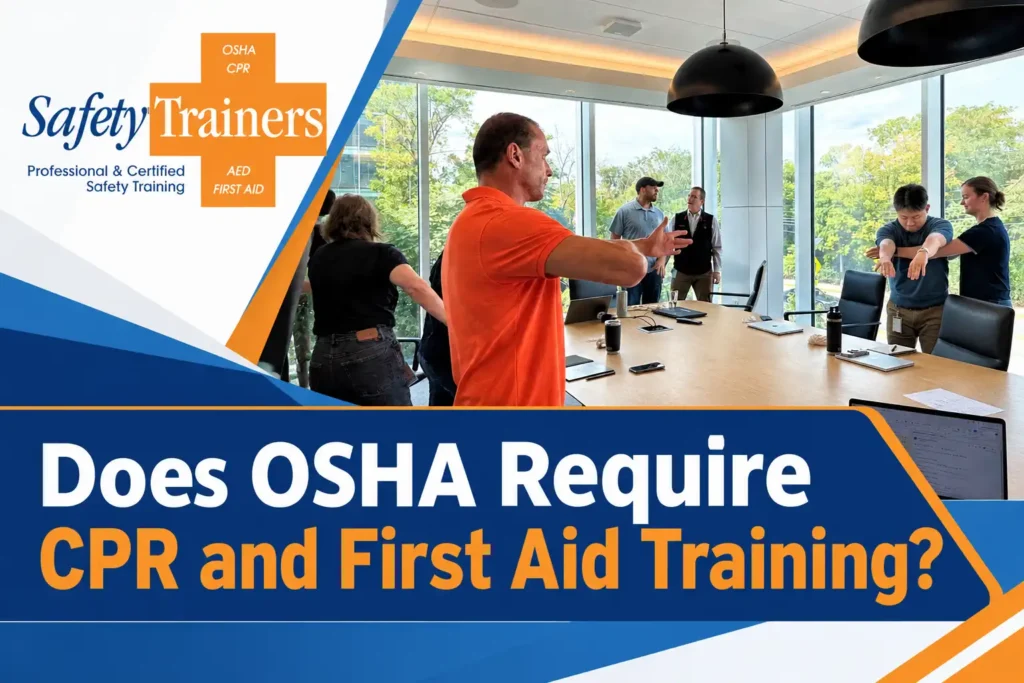
Short answer: OSHA does not require CPR certification in every workplace, but employers must have trained first aid providers when no clinic or hospital is in near proximity. That rule is 29 CFR 1910.151(b) for general industry and 29 CFR 1926.50(c) for construction. CPR is mandatory under a few hazard specific standards, and AEDs are recommended rather than required.
Most employers read that and still ask what it means for their own site. This guide explains what OSHA requires, how fast help must reach an injured worker, which industries must have CPR trained workers, what the rules say about AEDs, and how to build a first aid program that holds up in an inspection. It was written by the Safety Trainers team, a family owned company of OSHA authorized instructors founded in 1998 that delivers onsite CPR, first aid and AED training for employers.
What does OSHA say about first aid in the workplace?
OSHA’s general industry rule, 29 CFR 1910.151(b), says that when no infirmary, clinic or hospital is in near proximity to the workplace, a person or persons must be adequately trained to render first aid. Adequate first aid supplies must also be readily available.
The construction rule, 29 CFR 1926.50(c), works the same way. When no infirmary, clinic, hospital or physician is reasonably accessible by time and distance, someone with a valid first aid certificate, such as one from the American Red Cross or equivalent training that can be verified, must be available at the worksite.
All companies must have first aid but OSHA’s letters of interpretation say the CPR is recommended, . However, where a standard names CPR directly, like dental offices and employees who perform live electrical work, the requirement is binding.
How close is near proximity?
OSHA measures near proximity in minutes, not miles. Where suffocation, severe bleeding or other life threatening injuries can be expected, trained first aid must reach the injured worker within 3 to 4 minutes. Where a life threatening injury is unlikely, a response time of about 15 minutes is acceptable.
Few workplaces can count on an ambulance arriving in 3 to 4 minutes. OSHA has also said trained first aiders must be available on each shift and operation when no other emergency medical arrangements exist. One insurer’s loss control guidance goes further and suggests at least two to three trained employees per shift, because a single responder may be out of the building or hurt. The safe reading is simple: train people on every shift, at every location.
Which industries must have CPR trained workers?
| Situation | What OSHA requires | CPR named? |
| General industry with no clinic or hospital nearby | Trained first aid provider and supplies (1910.151(b)) | Recommended, not required |
| Healthcare workers like dental offices, fitness centers, golf courses and childcare Construction site without a reachable clinic or physician | Must be trained in CPR and AED First aid certificate holder on site (1926.50(c)) | Required Strongly advised |
| Permit required confined spaces | At least one member of the rescue team trained and current in CPR (1910.146) | Yes |
| Employees performing on live electricity under NFPA 70eElectric power generation, transmission and distribution | Must have a second person whose only job is to provide and render emergency response Two trained persons available for field work at exposed equipment of 50 volts or more (1910.269) | MUST be CPR/AED trained Yes |
| Commercial diving | Dive team members trained in CPR (1910.410) | Yes |
| Logging operations | Trained first aid and CPR (1910.266) | Yes |
If your work falls under one of these standards, CPR is a legal requirement and not just good practice. Check every standard that applies to your operations.
Responders may also fall under OSHA’s bloodborne pathogens standard, 29 CFR 1910.1030, because first aid can expose them to blood. It has its own training and recordkeeping rules, so many employers schedule it together with first aid renewals.
Do you need an AED at work?
OSHA does not require AEDs but states like Massachusetts require fitness centers, golf courses, dental offices and long-term care facilities and schools to have AEDs. Its best practices guide for workplace first aid programs says employers should consider AEDs when choosing first aid equipment, and it treats every worksite as a candidate for an AED program.
The case for one is strong. The American Heart Association reports about 10,000 cardiac arrests a year in the workplace, and Occupational Health and Safety magazine reports that immediate defibrillation can raise survival to as high as 60 percent, compared with 5 to 7 percent without it.
State law matters more than federal law here. Many states require AEDs in specific settings such as schools and fitness facilities, some add registration with local EMS, and some tie Good Samaritan immunity to meeting every requirement in the statute. Confirm your state’s rules before buying.
If you own an AED, maintain it. Pads typically expire every two to four years, and the status light on many devices checks only the battery. Inspect on a schedule and keep a log.
What belongs in a workplace first aid kit?
Section 1910.151(b) says only that supplies must be adequate. OSHA points employers to ANSI/ISEA Z308.1 (2021 edition) for minimum kit contents, although OSHA has not adopted that standard as a rule.
- Class A kits cover common workplace injuries and suit offices, warehouses and light manufacturing.
- Class B kits carry a broader range and larger quantities for higher risk worksites.
- Kits should be checked at least monthly and after every use, with expired items replaced.
Add supplies based on your hazards. Your OSHA 300 log is a good place to see which injuries your site actually has.
How many employees should be trained, and how often?
OSHA publishes no required ratio of trained employees to workers. Plan for coverage on every shift, in every building, and during absences and vacations.
CPR and first aid credentials are valid for two years. Renewal usually needs a hands on skills evaluation, so book it two or three months before the card expires. Stop the Bleed, which teaches tourniquet use and wound packing, is a separate short course many employers add.
Six steps to build a first aid, CPR and AED program
- Assess response time. Compare local EMS arrival times with the 3 to 4 minute benchmark and review your injury history.
- Name responders for every shift. Post their names and keep the roster current.
- Train hands on. Practice compressions, AED use and bleeding control on manikins, not just slides.
- Stock and check kits. Match ANSI/ISEA Z308.1 2021 and add hazard specific supplies.
- Place and maintain AEDs. Mark them clearly, track pad and battery dates, and check them on a schedule.
- Document everything. Keep rosters, certification dates, drills and incident follow ups ready for an inspector.
Why train onsite?
Onsite training brings the instructor, manikins and AED trainers to your facility, so a whole shift can be certified in one visit without travel. Safety Trainers teaches adult, child and infant CPR, first aid, BLS, opioid emergency response and Stop the Bleed, and schedules classes around your shifts. If you are unsure whether your current plan meets OSHA’s expectations, a compliance review can check your first aid program alongside your other written programs.
Ready to train your team? Call Safety Trainers at 774.241.0076 or email info@safetytrainers.com to schedule onsite CPR, first aid and AED training.
Frequently asked questions
Does OSHA require CPR certification for employees?
Not in every workplace. OSHA recommends CPR trained employees but requires trained first aid providers when medical help is not in near proximity. Standards for confined spaces, live electrical work, dental offices, healthcare, restaurants that seat greater than 25 employees, electric power work, commercial diving and logging require CPR trained workers.
Is an AED required in the workplace?
No federal OSHA rule requires AEDs. Some state and local laws require them in certain settings and set rules for registration and training.
How many employees need first aid training?
OSHA sets no ratio. You need trained providers on every shift and at every location, with enough people to cover absences.
How long is CPR certification valid?
American Heart Association and American Red Cross credentials are valid for two years. Renew before expiration, and expect a hands on skills evaluation.
Can CPR training be done online?
Many courses blend online learning with an in person skills check, and the hands on evaluation is what completes official certification.
Can OSHA cite an employer for not having trained first aiders?
Yes. If no clinic or hospital is in near proximity, failing to train first aid providers can be cited under 1910.151(b) or 1926.50(c). A serious violation can carry a penalty of up to $16,550.