A guest at table 12 stops talking. Hands go to the throat. The person across from them stands up and looks around for help.
Who on your floor right now knows what to do?
In Massachusetts, that isn’t only a good-practice question. If your restaurant seats 25 or more people, state law requires an employee trained in choke saving to be on site whenever food is being served. That means every shift, not just when your most experienced manager is working.
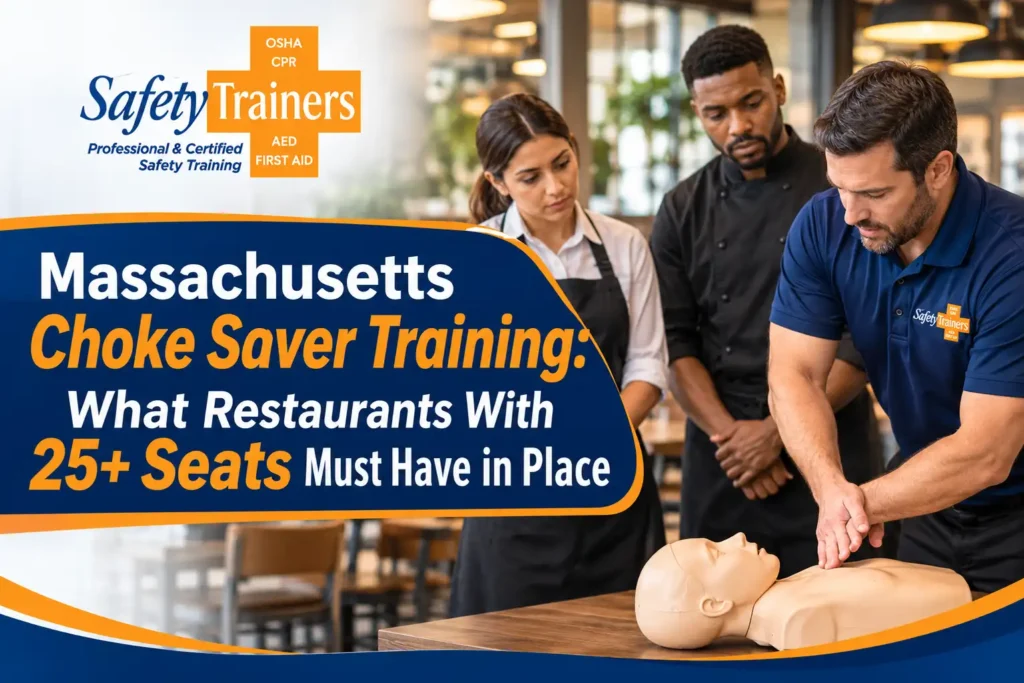
Getting compliant is simple. Massachusetts choke saver training is a short, hands-on class. Your staff leave knowing what to look for and what to do, your manager has a list of who is trained, and your inspector sees the paperwork in order.
Here’s what the law says, who it applies to, where most restaurants fall short, and how to get your team covered.
What the Law Requires
There are three pieces to know. Each one builds on the last.
The Statute
M.G.L. c. 94, § 305D
This is the state law. It covers restaurants with a seating capacity of 25 persons or more. A covered restaurant must:
- Have an employee on the premises, while food is being served, who is trained in manual procedures approved by the Department of Public Health (DPH) to remove food lodged in a person’s throat.
- Make adequate provision for insurance covering employees trained to give this help.
The statute also protects people who step in. A person or employee who, in good faith, tries to remove food lodged in someone’s throat in an emergency is not liable for civil damages for their acts or omissions in giving that help. Read the statute for the exact wording, and talk to your attorney or insurer about how it applies to you.
A note on devices: The statute also mentions a DPH-approved device as an option. DPH’s list of approved methods (105 CMR 605.000) names manual procedures only. Plan on trained staff. An anti-choking device can be a useful extra, but don’t count on it to meet the requirement.
The Food Code
105 CMR 590.011(A)
The Massachusetts food code repeats the statute’s requirement for food service establishments. Each establishment with 25 or more seats must:
- Have on its premises, while food is being served, an employee trained in DPH-approved manual procedures to remove food lodged in a person’s throat.
- Make adequate provision for insurance to cover employees trained in giving that help.
Heads up: Many local boards of health still cite the older section number, 105 CMR 590.009(E), on their forms and flyers. It’s the same requirement.
Approved Training
105 CMR 605.000
This regulation defines the approved procedures: the Heimlich maneuver and the sequence of obstructed airway maneuvers. It also adds a recordkeeping rule:
- Each restaurant with 25 or more seats must keep a list of employees trained in the approved procedures.
That list is one of the first things to have ready when an inspector walks in.
Does the 25-Seat Restaurant Requirement Apply to You?
Ask yourself these questions:
Can you seat 25 or more?
The rule is based on seating capacity, not employees. A 30-seat café with four employees is covered. A large kitchen with no seating may not be.
Food served every hour you’re open?
It applies whenever food is served, including early breakfast, late-night menus and slow weekday afternoons.
Seasonal, patio or bar seats?
Ask your local board of health how it counts seating for your permit. Don’t guess.
If you answered yes to the first question, the rule applies to you.
The Coverage Gap Most Restaurants Miss
Most restaurants don’t skip training on purpose. They fall short on coverage. Here’s how it usually happens:
One trained person
The GM took the class years ago. When they’re off, nobody on the floor is trained.
Turnover
The trained server left in the spring. Nobody replaced the training.
Expired cards
The training happened, but the cards have lapsed.
No list
People were trained, but no one can show the inspector who.
Build a shift-coverage plan
The fix is simple. Plan coverage the same way you plan staffing. Aim for trained staff on every shift:
- Train at least three people per shift, so a call-out doesn’t leave you uncovered.
- Include managers, shift leads and front-of-house staff. They’re closest to the guest.
- Add choke saver training to onboarding for new shift leads.
- Track card expiration dates in the same place you track other certifications.
What Heimlich Maneuver Training for Restaurant Staff Covers
A good class is short, practical and hands-on. Your staff should leave able to:
- Recognize choking. Know the signs and the universal choking sign, and tell a mild airway block from a severe one.
- Act fast. Use DPH-approved manual procedures to clear the airway.
- Adjust for the person. Know what changes for a guest who is pregnant or very large, or a child.
- Escalate. Know when and how to call 911 and what to do if the person stops responding.
- Assign roles. Who helps the guest, who calls 911, who meets EMS at the door and who manages the dining room.
Practice matters. Staff should get hands-on time, not just a video.
NEW: ANSI now lists choke saving devices as part of the first aid kits for restaurants. Do you have one?
Choke Saver Certificate: What Your Board of Health Will Look For
Each town handles inspections a little differently. Be ready to show:
- A current list of trained employees. Required under 105 CMR 605.004. Keep it where any manager can find it.
- Course completion cards for each trained employee. Some boards of health also ask for a training roster.
- Proof of coverage on every shift. Your schedule should show a trained employee on site whenever food is served.
- Insurance. Confirm with your agent that your policy covers employees who give this help, and keep that confirmation on file.
First decision: pick one person who owns this file. Without an owner, it falls apart after the first round of turnover.
Choking Response Training for Food Service: Action Items
Work through these in order.
| # | Action | Owner | Timeline |
|---|---|---|---|
| 1 | Confirm your seating capacity. | Owner or GM | This week |
| 2 | Map coverage by shift. List who is trained and when they work. Mark the gaps. | GM | This week |
| 3 | Book training. Cover the gaps first, then build to two trained people per shift. | Owner or GM | Within 30 days |
| 4 | Build the trained-employee list. Names, training dates and card expiration dates. | Assigned manager | Day of training |
| 5 | Confirm insurance. Call your agent and keep the confirmation on file. | Owner | Within 30 days |
| 6 | Set renewal reminders. Put expiration dates on the calendar 30 days out. | Assigned manager | Ongoing |
| 7 | Add training to onboarding. New shift leads and managers get trained before they run a shift alone. | GM | Ongoing |
Add Restaurant Staff First Aid Training in Massachusetts
Choking is one emergency. It isn’t the only one your team might face in a dining room or kitchen. While you’re scheduling choke saver training, consider:
CPR and AED
Choking can become a cardiac emergency if the person stops responding.
First aid
Cuts, burns and falls are common kitchen injuries.
Bloodborne pathogens
Covers staff who clean up after an injury.
One on-site session can cover several of these at once, so your staff are off the floor less.
Choke Saver Class in Worcester and Central Massachusetts
Safety Trainers is based in Central Massachusetts and trains restaurant teams across the state. Here’s how we work:
- On-site training at your restaurant, so your team doesn’t travel.
- Early, late, 2nd and 3rd shift scheduling to fit around service.
- Travel fees waived for first-time customers.
- Cards mailed to one contact, plus a QR code so each employee can get their own copy.
- Zero Gap Compliance: we call you 30 days before certifications expire and get you rescheduled.
- No outsourcing. You reach a decision maker when you call.
Book by [March 2027] and get a free anti-choking device for your restaurant.
The device is an extra layer, not a substitute — Massachusetts still requires a trained employee on site whenever food is served.
Frequently Asked Questions
Is choke saver training required for every Massachusetts restaurant?
It’s required for restaurants with a seating capacity of 25 or more. If you’re under 25 seats, training is still smart practice. Check with your local board of health for any local rules.
Is the requirement based on employees or seats?
Seats. Seating capacity decides whether the rule applies, not how many people you employ.
How many people need to be trained?
The law requires a trained employee on the premises whenever food is being served. In practice, that means training enough people to cover every shift, including call-outs and turnover.
Can an anti-choking device replace training?
Plan on trained staff. DPH’s approved list names manual procedures only. A device can support your response, but training is what meets the requirement.
What section of the food code covers choke saving?
The current section is 105 CMR 590.011(A). Many boards of health still reference the older number, 105 CMR 590.009(E).
Close the Gap Before It Matters
Choking happens fast. The person who can help needs to already be in the room.
If your restaurant seats 25 or more, Massachusetts choke saver training isn’t optional. Get the trained people, the list and the shift coverage in place now, so your team is ready and your inspection goes smoothly.
This post is general information, not legal advice. For the exact requirements, read the regulations below and check with your local board of health.
References
- M.G.L. c. 94, § 305D
- 105 CMR 590.011: Additional Requirements
- 105 CMR 605.000: Approved Manual Choke-Saving Procedures
Ready to get your team covered?
Call Safety Trainers or email us to schedule on-site choke saver training. Ask about the Black Friday free anti-choking device offer.