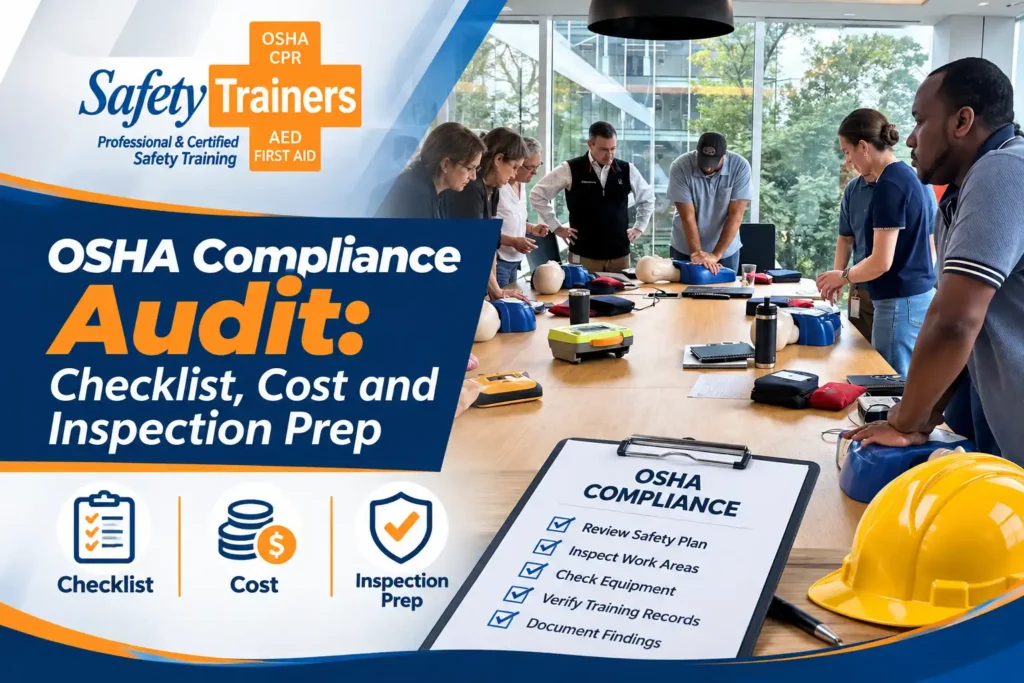
Short answer: An OSHA compliance audit is a proactive review of your workplace, records and written programs against the OSHA standards that apply to you, done by your team or an outside consultant instead of a government inspector. A thorough audit checks recordkeeping, written programs, training and the physical site, and ends with a written list of gaps and fixes. Many employers run one every year, and outside audits commonly run from a few thousand dollars for a single site.
The point is simple. You would rather find a missing hazard communication program yourself than learn about it from a citation. This guide explains what an audit covers, how it differs from an inspection and from OSHA’s free consultation program, what it costs, what happens during a real inspection and what to do if you receive a citation. It comes from Safety Trainers, a family owned team of OSHA authorized instructors serving employers since 1998 with OSHA compliance consulting and safety audits.
What is an OSHA compliance audit?
An audit measures your operation against OSHA requirements and finds gaps before an inspector does. It is not an official inspection, it carries no penalties and what you find stays under your control.
Three things get confused:
- An OSHA inspection is enforcement. A compliance officer visits, can issue citations and proposes penalties.
- A compliance audit is a private review by you or a consultant. You choose the scope, and the output is a corrective action plan.
- OSHA’s On Site Consultation Program offers free, confidential help to smaller businesses, run separately from enforcement. Employers who use it agree to fix serious hazards the consultant identifies, but no fines or citations result from the visit.
What does a safety audit cover?
| Area | What the auditor checks | Standard or form |
| Recordkeeping | OSHA 300 log, 300A summary and 301 incident reports, plus severe injury reporting | 29 CFR 1904 |
| Written safety program | Whether hazards, roles and procedures are written and current | General Duty Clause |
| Hazard communication | Chemical inventory, safety data sheets, labels and training | 1910.1200 |
| Energy Control | Lockout and tagout procedures, training and periodic inspections | 1910.147 |
| Emergency Action Plan | Emergency action plan, exits, alarms and drills | 1910.38 |
| Fire Protection | Extinguisher inspection and training, fire prevention plan | 1910.157 |
| Personal Protective Equipment | Hazard assessment and PPE selection and training | 1910.132 |
| Training records | Who was trained, on what, when and by whom | Training provisions in each standard |
| First aid | Trained providers, supplies and response time | 1910.151 |
| Industry specific rules | Fall protection, excavation, machine guarding, confined spaces | 1926 and 1910 by operation |
Audits on construction sites add the 29 CFR 1926 hazards, especially fall protection, scaffolding, excavation and electrical. An experienced auditor also interviews workers, because what people actually do often differs from what the written program says.
How often should you run an audit?
Most employers run a full audit once a year and smaller targeted reviews in between. Run an extra one after an injury, a near miss, a new process or chemical, a move to a new site or a change in management. A written record of each audit and the fixes that followed is also useful if OSHA ever asks about your safety management.
What does an OSHA compliance audit cost?
Cost depends on your size, number of sites, hazards and how deep the review goes. Published ranges from industry sources give a rough picture:
- Full facility audits are commonly quoted at about $2,500 to $8,000 depending on size and scope.
Multi site programs, specialized testing and remediation work raise the total. If you have fewer than about 250 employees at a site, check whether OSHA’s free On Site Consultation Program covers you before paying for a first review. Or contact Safety Trainers to see if you are eligible for any local funding sources.
What happens during a real OSHA inspection?
OSHA rarely gives notice. Inspections follow four stages in a fixed order:
- Opening conference. The officer shows credentials, explains why your site was selected and describes the scope.
- Document review. Expect requests for your injury logs, programs and training records.
- Walkaround. The officer tours the site, takes photos and notes, and may measure noise, air or equipment conditions.
- Interviews of employees. Employees are invited to speak with OSHA without a supervisor present.
- Closing conference. The officer discusses observations and likely next steps. Citations and fines, if any, arrive later in writing.
Name an inspection coordinator in advance, make sure managers know to be courteous and to answer what is asked without guessing, and keep records organized so you can produce them quickly. Check credentials at the door, and if you are unsure, call the OSHA area office to confirm. If you do not have a What To Do When OSHA Arrives Standard Operating Procedure [SOP] contact us. We will provide it to you at no cost.
What should you do if you get a citation?
You have 15 working days from receipt of the citation by mail to act. That is the single most important number in this guide. But, don’t wait to receive your citation in the mail. Immediately start working on corrective measures and training. If you need additional help in these areas, contact us. We will assist you in navigating this process.
By the time your citation letter arrives, you should have everything done or close to being competed. You will request an Informal Meeting and this is where you tell, show and provide proof of corrective actions and compliance with OSHA standards.
An informal meeting, allows good faith measures to be applied and changes to your citation letter can be modified to include combining citations, changing fine amounts, or a even getting the entire investigation dismissed.
In summary
- Correct. Fix the cited hazards by the abatement date
- Request an informal conference. You can meet with the OSHA area director to discuss the citation, and settlements are possible. An informal conference does not extend the 15 working day deadline. OR
- File a notice of contest. A written notice must reach OSHA within 15 working days to challenge the citation, the penalty or the abatement date. If you do not contest in time, the citation becomes a final order that no court or agency can review.
You must also post the citation near the affected work area for three working days or until the violation is corrected, whichever is longer. Maximum penalties for 2026 remain $16,550 for a serious violation, $165,514 for a willful or repeated violation and $16,550 per day for failure to abate, because OSHA made no inflation adjustment this year. Proposed penalties are often lower than the maximums.
Six steps to run an audit that gets results
- Set scope. List your sites, operations and the standards that apply.
- Gather documents. Pull injury logs, written programs, training records and inspection reports.
- Walk the site. Check conditions against each standard and talk to workers and supervisors.
- Rate findings. Rank each gap by severity and likelihood of injury.
- Assign fixes. Give every finding an owner, a fix and a due date.
- Verify and repeat. Confirm each fix, photograph it and schedule the next audit.
How Safety Trainers can help
Safety Trainers offers OSHA compliance reviews, written safety policy development, mock inspections, citation mediation support and safety officers for hire, backed by in-house instructors who can close training gaps right away. Findings from an audit often point straight to training needs, and we deliver those onsite, such as OSHA 10 and 30 hour classes and fire extinguisher service and training. Finally, we can help you create any missing documentation to include policy, procedures, forms and checklists.
Ready to find your gaps before OSHA does? Call 774.241.0076 or email info@safetytrainers.com to schedule a compliance review.
Frequently asked questions
What is an OSHA compliance audit?
A proactive review of your workplace and safety programs against applicable OSHA standards, done by your team or an outside consultant, ending in a written list of gaps and corrective actions.
How often should you do an OSHA compliance audit?
At least once a year for most employers, plus after incidents, new processes or changes in operations.
Is an audit the same as an OSHA inspection?
No. An inspection is an enforcement visit by OSHA that can lead to citations. An audit is a private review that carries no penalties.
Is there a free OSHA consultation?
Yes. OSHA’s On Site Consultation Program provides free, confidential help to smaller businesses and operates separately from enforcement. You must agree to correct serious hazards that are found.
How long do you have to contest an OSHA citation?
15 working days from receipt. An informal conference does not extend that deadline.
How much does an OSHA audit cost?
Common industry estimates run from about $2,500 to $8,000 for a full facility audit, depending on size and scope. A quote from your consultant is the only reliable number.